Register once, drag and drop ECAD models into your CAD tool and speed up your design.
Click here for more informationNPIC6C4894D
Power logic 12-bit shift register; open-drain outputs
The NPIC6C4894 is a 12-stage serial shift register. It has a storage latch associated with each stage for strobing data from the serial input (D) to the parallel open-drain outputs (QP0 to QP11). Data is shifted on positive-going clock (CP) transitions. The data in each shift register stage is transferred to the storage register when the latch enable (LE) input is HIGH. Data in the storage register drives the gate of the output extended-drain NMOS transistor whenever the output enable input (OE) is HIGH. A LOW on OE causes the outputs to assume a high-impedance OFF-state. Operation of the OE input does not affect the state of the registers. Two serial outputs (QS1 and QS2) are available for cascading a number of NIC6C4894 devices. Serial data is available at QS1 on positive-going clock edges to allow high-speed operation in cascaded systems with a fast clock rise time. The same serial data is available at QS2 on the next negative going clock edge. It is used for cascading NPIC6C4894 devices when the clock has a slow rise time. The open-drain outputs are 33 V/100 mA continuous current extended-drain NMOS transistors designed for use in systems that require moderate load power such as LEDs. Integrated voltage clamps in the outputs, provide protection against inductive transients. This protection makes the device suitable for power driver applications such as relays, solenoids and other low-current or medium-voltage loads.
Alternatives
Features and benefits
Specified from ?40 °C to +125 °C
Low RDSon
12 Power EDNMOS transistor outputs of 100 mA continuous current
250 mA current limit capability
Output clamping voltage 33 V
30 mJ avalanche energy capability
Low power consumption
Latch-up performance exceeds 100 mA per JESD 78 Class II level A
ESD protection:
HBM JS-2011 Class 2 exceeds 2500 V
CDM JESD22-C101E exceeds 1000 V
Applications
LED sign
Graphic status panel
Fault status indicator
參數(shù)類型
| 型號 | Package name |
|---|---|
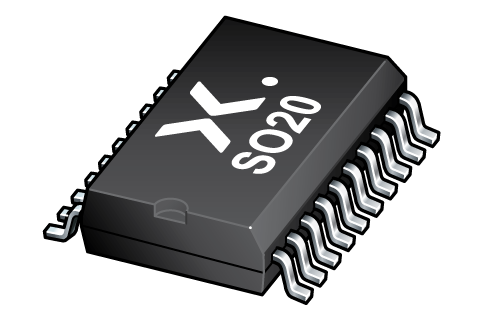
| NPIC6C4894D | SO20 |
PCB Symbol, Footprint and 3D Model
| Model Name | 描述 |
|---|---|
|
|
封裝
下表中的所有產(chǎn)品型號均已停產(chǎn) 。
| 型號 | 可訂購的器件編號,(訂購碼(12NC)) | 狀態(tài) | 標(biāo)示 | 封裝 | 外形圖 | 回流焊/波峰焊 | 包裝 |
|---|---|---|---|---|---|---|---|
| NPIC6C4894D | NPIC6C4894DY (935302549518) |
Withdrawn / End-of-life |
SO20 (SOT163-1) |
SOT163-1 |
WAVE_BG-BD-1
|
SOT163-1_518 | |
| NPIC6C4894DJ (935302549118) |
Obsolete | SOT163-1_118 |
環(huán)境信息
下表中的所有產(chǎn)品型號均已停產(chǎn) 。
| 型號 | 可訂購的器件編號 | 化學(xué)成分 | RoHS | RHF指示符 |
|---|---|---|---|---|
| NPIC6C4894D | NPIC6C4894DY | NPIC6C4894D |

|


|
| NPIC6C4894D | NPIC6C4894DJ | NPIC6C4894D |
|

|
Series
文檔 (10)
| 文件名稱 | 標(biāo)題 | 類型 | 日期 |
|---|---|---|---|
| NPIC6C4894 | Power logic 12-bit shift register; open-drain outputs | Data sheet | 2017-04-07 |
| AN11537 | Pin FMEA for NPIC Family | Application note | 2019-10-07 |
| AN90063 | Questions about package outline drawings | Application note | 2025-10-22 |
| SOT163-1 | 3D model for products with SOT163-1 package | Design support | 2020-01-22 |
| npic6c4894 | NPIC6C4894 IBIS model | IBIS model | 2016-05-30 |
| Nexperia_document_leaflet_Logic_NPIC_ShiftRegisters_201906 | NPIC Logic Shift Registers | Leaflet | 2019-07-12 |
| Nexperia_package_poster | Nexperia package poster | Leaflet | 2020-05-15 |
| SOT163-1 | plastic, small outline package; 20 leads; 1.27 mm pitch; 12.8 mm x 7.5 mm x 2.65 mm body | Package information | 2024-11-15 |
| NPIC6C4894D_Nexperia_Product_Reliability | NPIC6C4894D Nexperia Product Reliability | Quality document | 2022-05-04 |
| WAVE_BG-BD-1 | Wave soldering profile | Wave soldering | 2021-09-08 |
Longevity
The Nexperia Longevity Program is aimed to provide our customers information from time to time about the expected time that our products can be ordered. The NLP is reviewed and updated regularly by our Executive Management Team. View our longevity program here.
模型
| 文件名稱 | 標(biāo)題 | 類型 | 日期 |
|---|---|---|---|
| npic6c4894 | NPIC6C4894 IBIS model | IBIS model | 2016-05-30 |
| SOT163-1 | 3D model for products with SOT163-1 package | Design support | 2020-01-22 |
PCB Symbol, Footprint and 3D Model
| Model Name | 描述 |
|---|---|
|
|
How does it work?
The interactive datasheets are based on the Nexperia MOSFET precision electrothermal models. With our interactive datasheets you can simply specify your own conditions interactively. Start by changing the values of the conditions. You can do this by using the sliders in the condition fields. By dragging the sliders you will see how the MOSFET will perform at the new conditions set.